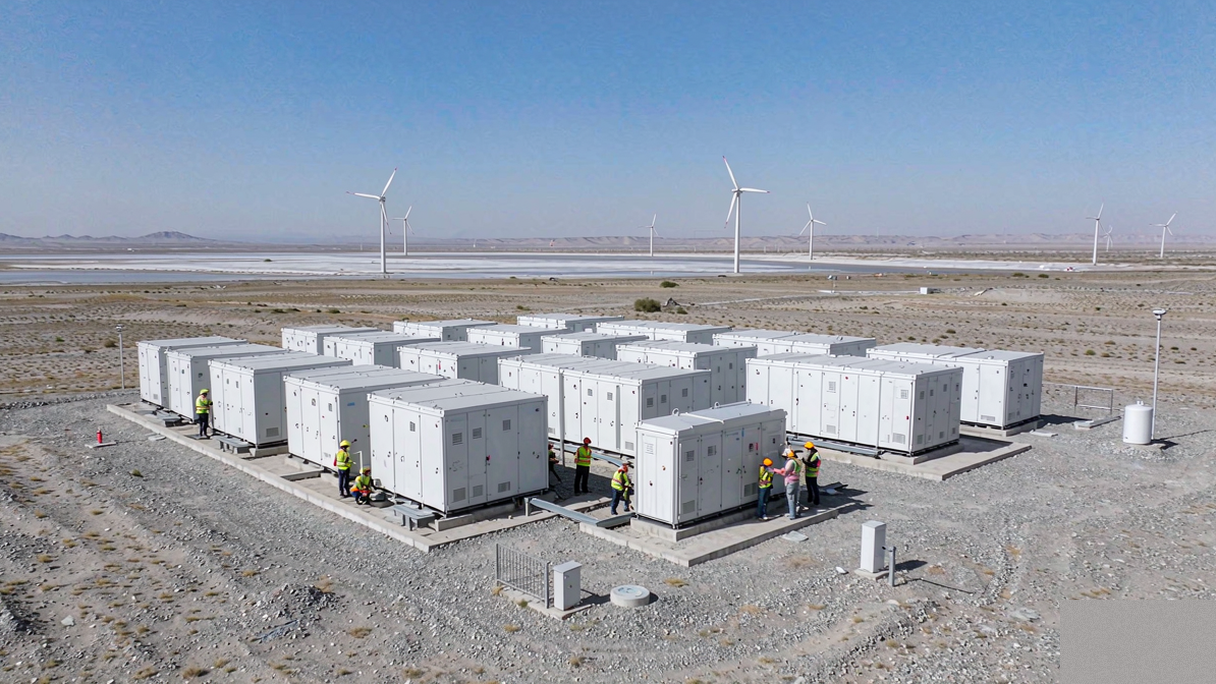
On September 8, the official website of China Three Gorges Corporation published a release stating that the Inner Mongolia Autonomous Region major science-and-technology special project "Megawatt-Scale Aqueous Sodium-Ion Battery Energy Storage Key Technology Research" - undertaken by China Three Gorges' Science and Technology Research Institute - successfully passed its performance review in Ulanqab, with leaders from the Inner Mongolia Department of Science and Technology, Ulanqab Bureau of Science and Technology and industry experts attending the review meeting. The project built China's first megawatt-class aqueous sodium-ion battery demonstration plant, leveraging inherently safe, environmentally friendly and cost-controllable core technology to deliver a full-chain storage solution spanning materials preparation, cell manufacturing, system integration and engineering deployment. The expert panel comprehensively reviewed the project and unanimously concluded that it had addressed the core scientific questions of aqueous sodium-ion battery energy storage, resolved key technical challenges in high-safety electrolyte systems, long-life cell design, megawatt-scale system integration and source-grid-load-storage coordinated control, fully delivered all research tasks and assessment metrics, and approved the project's passing of the performance review. The project's outcomes provide a replicable and promotable demonstration template for scaled new-type storage deployment in Inner Mongolia and contribute to the diversified development of China's new-type energy storage technologies.
Aqueous sodium-ion batteries use water-based electrolytes in place of organic ones, offering materially higher inherent safety than organic lithium/sodium-ion systems (no organic-electrolyte combustion risk) and stronger raw-material and manufacturing cost advantages; however, their energy density is typically lower than that of organic-system sodium batteries (often in the 50-100 Wh/kg range), making them more suited to long-duration storage, applications where volumetric energy density is not the primary constraint, and scenarios with stringent safety requirements. As China's largest clean-energy central state-owned enterprise, China Three Gorges' undertaking of this Inner Mongolia major S&T special and the construction of the country's first MW-class aqueous sodium-ion demonstration plant crosses the critical threshold from "gram-level material validation" to "megawatt-class engineering demonstration".
The project simultaneously emphasizes full-chain coordination - spanning high-safety electrolyte systems (materials), long-life battery cells (devices), megawatt-scale system integration (equipment) and source-grid-load-storage coordinated control (system) - signaling that aqueous sodium-ion batteries have the capability to move out of the laboratory into engineering demonstration. Note that "passing the performance review" is a project-closure milestone for the research program; it is not equivalent to commercial operation or grid-connected deployment. The demonstration plant remains at the demonstration/validation stage, and large-scale commercialization of aqueous sodium-ion batteries still requires further engineering and reliability verification.
Across the full sodium-ion technology route map, organic-electrolyte sodium batteries (polyanion, layered oxide, Prussian blue) constitute the mainstream commercialization direction - the 293.7 GWh planned capacity in the CNESA survey (see 20260908-001) is dominated by organic systems. China Three Gorges' construction of China's first megawatt-class aqueous sodium-ion demonstration plant and its passing of the Inner Mongolia major S&T special performance review is a key engineering-validation milestone for this route, underscoring the industry reality of parallel diversified technology pathways: organic-system sodium-ion batteries focus on energy density and commercialization, while aqueous sodium-ion batteries explore inherent safety and low cost - the two paths are complementary rather than substitutive, addressing different application scenarios.