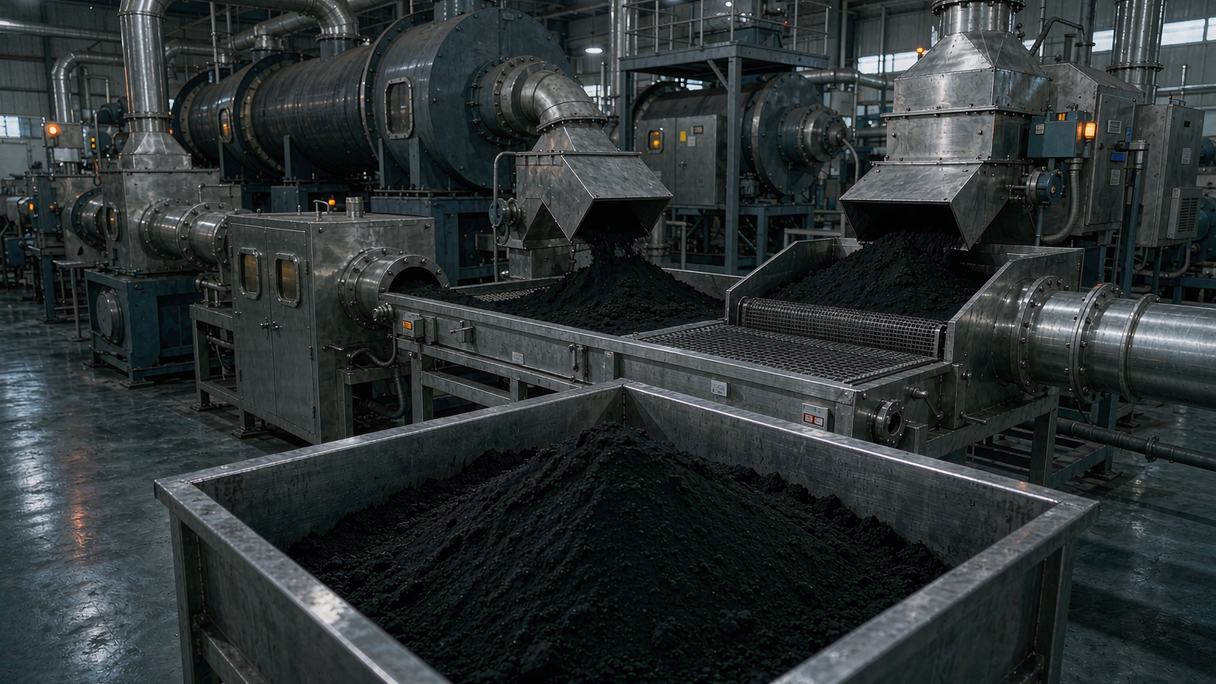
On September 1, the reply to the review inquiry letter (Zhong Hui Zi (2026) No. 12349; inquiry issued by the Shenzhen Stock Exchange on July 20, 2026) for Shanghai Xiangfenghua Technology's (300391) private placement of shares was disclosed. The reply shows the company plans to raise CNY 600 million for a '93,000 tpa new energy battery anode materials project': to be built by Sichuan Xiangfenghua in Pengxi County, Suining, Sichuan, with total investment of CNY 1.36 billion; the product mix comprises 80,000 tpa artificial graphite anode, 10,000 tpa silicon-carbon composite anode, 2,700 tpa hard carbon anode and 300 tpa porous carbon. The reply explicitly states that the company's silicon-carbon composite anode, hard carbon anode and porous carbon are used in next-generation storage/power batteries such as semi-solid/all-solid-state batteries and sodium-ion batteries.
On sodium relevance, the reply states: hard carbon is a non-graphitizable carbon material with high specific capacity, excellent cycling stability and good rate performance, and is the main anode material choice for sodium-ion batteries; in 2025 sodium-ion batteries achieved scaled application in energy storage, two-wheelers, power and start-stop power supply scenarios, and EV Tank forecasts actual sodium-ion battery shipments of 435GWh by 2030, whose growth will pull the hard carbon anode market in tandem.
For feedstock, the core raw materials of hard carbon and porous carbon are biomass such as coconut shell and bamboo, with low value and wide availability. The company also disclosed that as orders for its 300mAh/g and 320mAh/g products are executed, a market foundation for hard carbon capacity absorption will be laid; as of end-2025 the company had no built capacity for silicon-carbon, hard carbon or porous carbon, and the fundraising project has a 3-year construction period, releasing capacity from the third year and reaching full capacity within 2 years after completion.
: the placement still needs Shenzhen Stock Exchange review and CSRC registration; the construction period is 3 years, planned capacity does not equal actual capacity, and commissioning and full ramp-up are expected years away; as of end-2025 the company had no built hard carbon capacity, and the '300mAh/g and 320mAh/g product orders' are figures disclosed in the review documents, with order size and customer names not public; 2,700 tpa is relatively limited in the current sodium hard carbon expansion wave, representing an extension by a traditional graphite anode maker into sodium materials.